For 20 years I’ve had a great career. I’m a self-taught designer and developer, working on websites and branding — both my own clients and supporting with agency work. In all that time, I’ve managed to get by on word of mouth alone. I’ve not really had to do any self-promotion and I’ve actively shied away from marketing myself. When you’re busy with client work, your own marketing sits at the bottom of the to-do list.
But it’s 2026 and it’s time for a change. I want to sharpen my branding and start actively marketing Styles Studio effectively.
It’s hard to articulate your own offering. I know this from seeing clients wrestle with their own positioning, but it’s essential if you want to get the work that stimulates you and aligns with your beliefs. As Aristotle said, Knowing yourself is the beginning of all wisdom. It’s also the start of a decent branding project.
When I started putting together my own posts and marketing, the need became obvious. What should I post? Who should I target? What projects should I chase?
As I say to my clients: good design is the articulation of a good strategy. But first, you need a good strategy.
The best way to get to that is be working out who you are and what you believe in.
Question Time
I started by asking myself the same questions I ask my clients, things like:
What actually drives how I work?
What do I think is true about design that others might disagree with?
If the brand were a person, who would they be?
Who is my offering actually for?
It’s harder when you’re asking yourself, I much prefer the built in objectivity of asking someone else. When you’re so close to it, I think it’s easy to get unstuck here. Who am I can lead to bigger existential questions, and it’s really hard to view yourself and your own work objectively. I think this is one reason why creatives often struggle to do their own branding work
The opposite test
I started by listing everything that felt important. Honesty. Quality. Collaboration. Creativity. The list got long quickly. But “feeling true” isn’t enough – if everything’s a value, nothing is.
So I applied a filter, which is quite a good one: for a value to count, the opposite has to be something another business might genuinely choose.
For example, “Professional” doesn’t pass. Because no business would describe themselves as unprofessional.
“Authentic” doesn’t pass either. Authenticity isn’t a choice you make – it’s a perception others have when your actions match your words. You can’t declare yourself authentic. You can only demonstrate it.
But “honesty” does pass – the opposite is telling clients what they want to hear, avoiding hard conversations. Plenty of agencies do this.
“Craft” passes — the opposite is optimising for speed and volume. Good enough, ship it, next.
“Collaboration” passes – the opposite is the black box model. Client briefs, agency disappears, big reveal at the end. This is against the way I work but also against how I want my working life to be – sharing and developing with other people is where the joy of my work comes from.
The personality sliders
Values tell you what you stand for. Personality informs how you come across, your brands tone-of-voice.
I use a slider exercise — pick a position on a slider out of eight – it intentionally has no exact mid-point, so you to side one way or the other
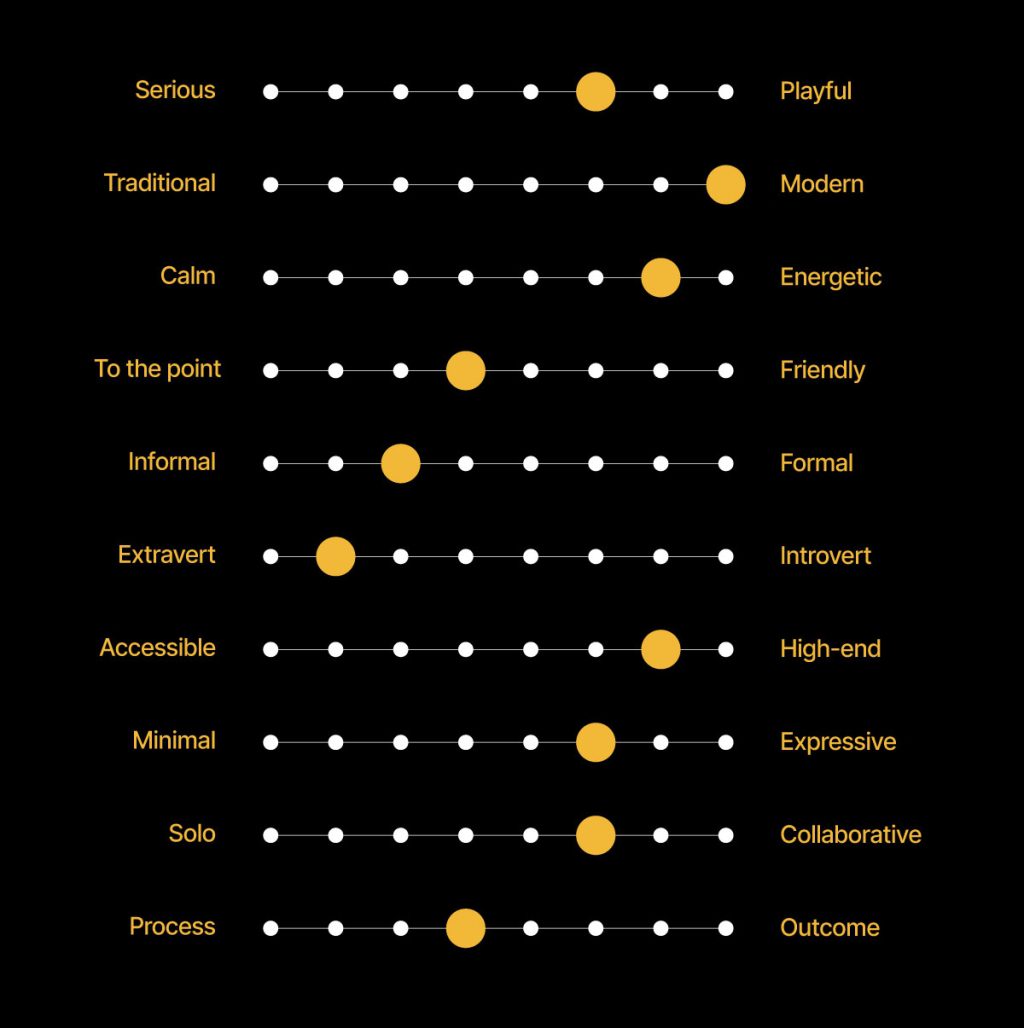
I'm still not completely sold on all of these, but it's a good start.
What I landed on: Four values
- Honesty
Truth in service of the work, never ego. Encouraging openness and debate. Always positive. - Craft
The making matters. Every detail, every project, always learning. Building the right thing for each client. - Collaboration
Equals working together. The sum greater than the parts. Built with you, not for you. - Openness
Open by default. Knowledge shared, not hoarded. We think about what we put into the world.
What I landed on: Seven beliefs
- Design should do something. Make a difference, not just an impression.
Design can't force a connection — but it can make the right one easier. If it doesn't serve a purpose, it's just decoration. - Start with questions. Understand the why before the how.
Good design is the articulation of a strategy. But first, you need a good strategy. Skip it and you're guessing. - Simplicity is hard-won. Built to last, not to trend.
Easy to use doesn't mean easy to make. We compress, refine, and strip back until only what matters remains. - Everything should earn its place. If it's not adding, it's distracting.
Every element needs a reason. Restraint is a skill. We add with intention and remove without sentiment. - Serve the user, not the ego. We're not the audience.
It's not about what we like. It's not about what the client likes. It's about what works for the people the work is for. - Honesty serves the work. Say what you think — with warmth, not edge.
If something isn't working, we'll say so — but always constructively, always as partners. Honesty isn't about being blunt. It's about caring enough to speak up. - Good work is built together. The right work energises everyone.
No handoffs. No big reveals. When both sides are invested and excited, the work is always better. That energy shows.
Why this matters
These are the starting point for creating a solid brand. The design and content that makes up the brand needs to articulate something, it needs a defined audience, and all those things come from this starting point. Clarity on this means we have something to work with, and against.
What's next
This is the foundation. I'm going to sit with it for a bit, then develop the strategy and visual direction. It's a line in the sand and may well change, but it's a starting point.
Excited to get this started :)